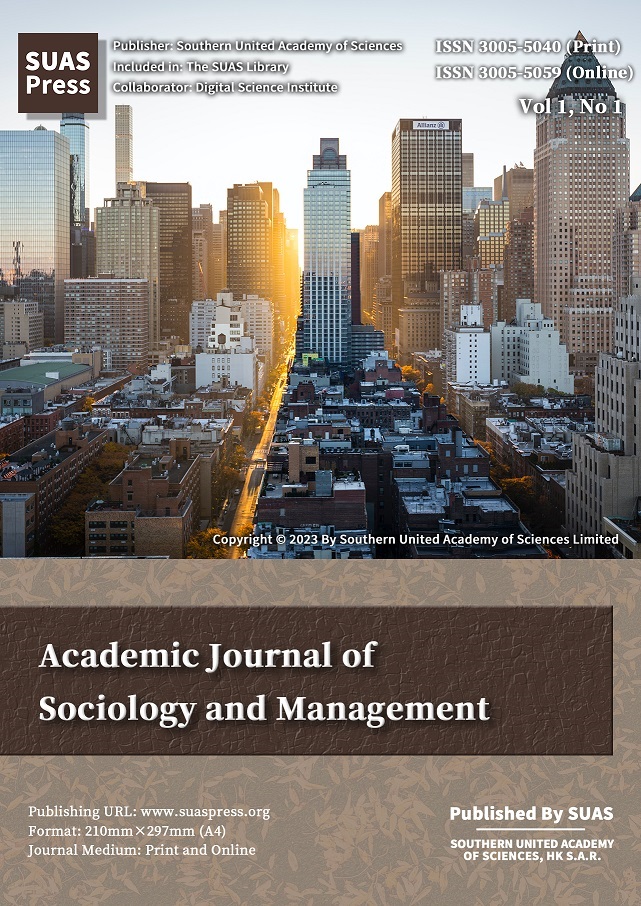
Current Issue

All articles published in this issue have undergone a thorough peer review process, and stringent checks for repetition rates have been implemented to ensure the integrity of the content.

Total number of articles in this issue: 7
Total number of pages in this issue: 49

For inquiries regarding the content of specific articles, please feel free to contact the respective authors via their provided email addresses. For questions related to the journal itself, please reach out directly to SUAS Press.

Year

2025

Volume

3

Number

3

Status

Archived

Published

2025 May 15

Articles

Tuzhi Pilots Subvert the Traditional Customized Future Education

The rapid development of Internet technology has promoted the rapid popularization of online education platforms and created new opportunities for personalized smart education. The academic and industrial sectors are constantly increasing their attention to recommendation algorithms. Although these algorithms have achieved remarkable results in the e-commerce field, they still face problems such as insufficient mining of implicit interactive data, insufficient knowledge guidance, and lack of practical recommendation systems in online education. To solve these challenges, we have built a smart course recommendation system for industrial applications. By mapping the implicit interaction data between users and courses into heterogeneous diagrams, and integrating course knowledge information to deeply analyze the complex connections between users and courses, we have designed an efficient pipeline that includes preprocessing, recall, offline sorting, online recommendation and results, which not only achieves rapid response to recommendation requests, but also effectively alleviates practical application problems such as cold start. Finally, comparative experiments based on real teaching platform data verified that the system has significant advantages in performance and application.

DOI10.70393/616a736d.323930ARKark:/40704/AJSM.v3n3a01

A New Paradigm of Personalized Education Driven by Multi-Agent Collaboration

In order to promote the in-depth development of intelligent education, this paper proposes an intelligent collaboration framework that integrates general-purpose large language models and professional small models. By integrating the broad language comprehension ability of the general model and the fine grasp of subject knowledge of the domain-specific model, and combining the teaching mechanism in learning theory, the framework realizes a diversified knowledge construction method and supports a highly personalized and dynamically adaptive learning experience. We further explore the practical application scenarios of the framework in intelligent education, and demonstrate its potential in teaching assistance, learning guidance and knowledge transfer. With the continuous evolution of artificial intelligence technology, the collaborative system is expected to become a key engine to promote the intelligent transformation of education in the future.

DOI10.70393/616a736d.323931ARKark:/40704/AJSM.v3n3a02

Real Time Sales Forecasting in Omnichannel Retail Using a Hadoop Based Hybrid CNN–LSTM Deep Learning Framework

In an omnichannel retail environment, accurate real time sales forecasts are critical for inventory optimisation and dynamic pricing. This study proposes a Hadoop based hybrid CNN–LSTM deep learning framework that leverages Hadoop’s distributed computing capabilities to process almost 20 million multi source sales records collected over two years. The convolutional layers and recurrent layers cooperate to capture local pulses and long range dependencies, respectively. Systematic experiments show that, compared with classical ARIMA and various machine learning baselines, the proposed model reduces the mean squared error (MSE) by approximately 45 % and increases the coefficient of determination (R²) by about 15 %. Within randomly selected 30 day windows, the model stably tracks high frequency intra week fluctuations while effectively suppressing noise spikes. Moreover, the Hadoop cluster shortens the total training time from 14 h to 3.5 h and compresses single inference latency to 48 ms, satisfying second level business decision requirements. Ablation studies further verify the complementary benefits of the convolutional and recurrent components; removing either leads to significant performance degradation. After deployment at a partner retailer, the stock out rate and dead inventory were reduced by 7.8 % and 6.1 %, respectively, demonstrating the commercial value of the approach. Limitations include cold start bias for new items, underestimation of extreme promotion peaks and insufficient model interpretability. Future work will explore graph convolution to incorporate spatial correlations, self supervised pre training to alleviate cold starts and attention mechanisms to enhance interpretability—thus driving retail sales forecasting towards greater accuracy, trustworthiness and inclusiveness.

DOI10.70393/616a736d.323932ARKark:/40704/AJSM.v3n3a03

AI Driven Digital Transformation in the Architecture Industry with Technical Implementation and Business Process Optimization Review

There is a big digital revolution emerging in architecture, driven by ML (Machine Learning) and AI (Artificial Intelligence). These technologies have brought the design–construction–building lifecycle process much closer to modern working methods, and they have complemented, rather than replaced, existing systems. In this article, we present an overview of AI-facilitated digital transformation in architecture, focusing on three key technologies: generative design, computer vision, and natural language processing (NLP), and showing how they improve businesses in both strategic and operational aspects. For a more tangible perspective, we showcase, through specific applications and emerging tools, how AI enhances design quality, efficiency, sustainability, and client experience. The report also highlights major barriers to AI implementation, from lack of data interoperability and skills shortages to company culture. This article demonstrates how AI is disrupting established architectural practices, and the ways in which its fusion with business models and market forces will shape the future of the built environment.

DOI10.70393/616a736d.323934ARKark:/40704/AJSM.v3n3a07

Design of Persona-Based Interactive Interfaces and Their Impact on Human Self-Perception

Grounded in the frameworks of affective computing and large-language-model technology, this paper systematically sorts out the conceptual evolution and core techniques of persona-based interactive interfaces (PBIIs) and, by means of a randomized controlled experiment, verifies their comprehensive effect on users’ self-perception. The study first constructs a four-level closed-loop architecture of “Perception – Understanding – Generation – Feedback.” Sixty university students are then recruited for a 14-day intervention; pre- and post-tests using a Self-Efficacy Scale and an Emotion-Awareness Test are compared. Results show a significant rise in self-efficacy for the experimental group (ΔM = +0.70, p < 0.01) and a 12 % increase in emotion-recognition accuracy, validating the synergistic mechanism of affective mirroring and verbal persuasion. Qualitative interviews further reveal potential risks such as emotional dependence and cognitive dissonance. In view of these findings, this paper proposes PBII design principles centred on uncertainty management and user-agency cues, offering theoretical and practical reference for responsible application in education and mental-health fields.

DOI10.70393/616a736d.323936ARKark:/40704/AJSM.v3n3a05

AI-Powered Translation and the Reframing of Cultural Concepts in Language Education

This study examines how artificial-intelligence (AI) technologies reshape cultural concepts in the domains of translation and language education. By analyzing the ways AI facilitates precise cross-lingual transfer while adapting cultural elements during translation, we show how intelligent machine-translation (MT) systems guide users toward deeper understanding of target-language cultures and ultimately influence their own cultural identities. The paper also investigates AI-powered online language-learning platforms, exploring how they embed cultural content into course design and pedagogy to enhance learners’ intercultural communicative competence. Case studies reveal that AI not only boosts linguistic accuracy but also opens new educational models and practical pathways for cultural integration—such as personalized learning schemes grounded in big-data analytics and natural-language processing (NLP). Consequently, the wide deployment of AI supplies technological support for culturally responsive language education, promotes more profound and effective intercultural exchange, and fosters cultural understanding and identification in today’s globalized context. The findings provide theoretical underpinnings and practical directions for future translation and language-education practice, while opening new perspectives for interdisciplinary research between AI and the humanities.

DOI10.70393/616a736d.323937ARKark:/40704/AJSM.v3n3a06

Exploring the Risk Mechanisms and Preventive Countermeasures of College Students' Ideological Education Innovation in the Age of Artificial Intelligence

At present, artificial intelligence technology provides an important breakthrough for the innovation and development of China's education field, and the emerging various types of artificial intelligence technology are profoundly and continuously affecting the learning life of college students, and the association between the development of the ideological education field and the application of artificial intelligence technology is becoming more and more close. Ideological education as an important topic of ideological and political education and teaching work, artificial intelligence technology for college ideological education has brought a new picture, to realize the intelligent integration of artificial intelligence technology into the ideological education of colleges and universities, to drive the high-quality development of ideological education. It is of great significance to analyze the risk mechanism and preventive countermeasures for college students' ideological education from the perspective of the application of artificial intelligence.

DOI10.70393/616a736d.323938ARKark:/40704/AJSM.v3n3a04

Copyright © 2026 The Author(s). Published by Southern United Academy of Sciences.
This work is licensed under a Creative Commons Attribution 4.0 International License , which permits unrestricted use, distribution, and reproduction in any medium, provided the original work is properly cited.