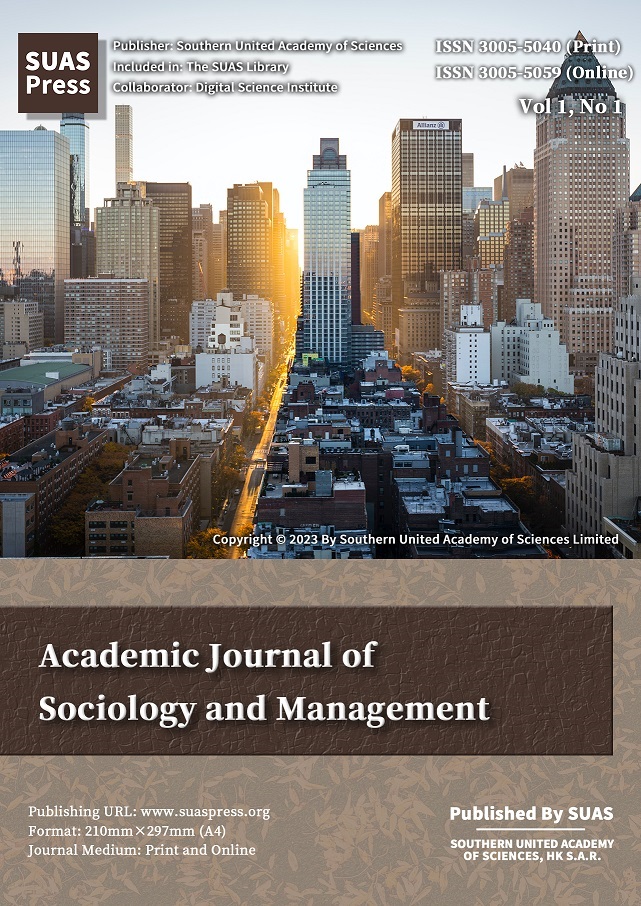
Current Issue

All articles published in this issue have undergone a thorough peer review process, and stringent checks for repetition rates have been implemented to ensure the integrity of the content.

Total number of articles in this issue: 3
Total number of pages in this issue: 25

For inquiries regarding the content of specific articles, please feel free to contact the respective authors via their provided email addresses. For questions related to the journal itself, please reach out directly to SUAS Press.

Year

2025

Volume

3

Number

4

Status

Archived

Published

2025 July 13

Articles

An Analysis of the Dialectical Relationship between Chinese-style Modernization and the Cohesion of the Chinese Nation

Chinese modernization and the cohesion of the Chinese nation have the homology of theoretical basis, the consistency of goal pursuit and the compatibility of practical path. The two complement each other and support each other. By tracing the theoretical roots of Marxist theory and Chinese excellent traditional culture, this paper analyzes the value pursuit of national rejuvenation and people 's happiness, as well as the relationship between economic, cultural, social and other practical levels, and clarifies the internal relationship and logical path between Chinese modernization and the cohesion of the Chinese nation. It is of great theoretical and practical significance to enhance the cohesion of the Chinese nation in the new era, further deepen the understanding and practice of the people of all ethnic groups on the pattern of pluralistic integration of the Chinese nation, promote the formation of a closer community of destiny among all ethnic groups in the common cultural identity and value pursuit, and help promote the sustainable development of the great rejuvenation of the Chinese nation.

DOI10.70393/616a736d.323939ARKark:/40704/AJSM.v3n4a01

Legal Application and Institutional Improvement of CFIUS Review Mechanisms in Cross-Border Lithium Battery Investments: A Framework Analysis for Balancing National Security and Investment Facilitation

This study examines the legal application and institutional improvement requirements for Committee on Foreign Investment in the United States (CFIUS) review mechanisms in cross-border lithium battery investments, addressing the critical balance between national security protection and investment facilitation. Through comprehensive analysis of statutory frameworks under the Foreign Investment Risk Review Modernization Act (FIRRMA) of 2018 and the Foreign Investment and National Security Act (FINSA) of 2007, this research identifies systematic challenges in current regulatory approaches to critical energy technology oversight. The investigation analyzes CFIUS case precedents, enforcement actions, and regulatory decisions from 2019-2024, revealing significant jurisdictional ambiguities in emerging technology classifications, procedural inefficiencies impacting investment climate predictability, and enforcement gaps in post-transaction monitoring. Based on examination of CFIUS Annual Reports to Congress, Congressional Research Service (CRS) analyses, and Government Accountability Office (GAO) assessments, this study demonstrates that existing CFIUS frameworks encounter substantial limitations when addressing sophisticated lithium battery technologies, with regulatory uncertainty creating delays averaging 156-203 days for critical technology transactions. The study proposes comprehensive institutional reforms incorporating risk-proportionate assessment protocols, enhanced legal clarity in technology classifications, and streamlined review processes grounded in established CFIUS jurisprudence. Recommendations emphasize implementation of tiered security screening mechanisms aligned with FIRRMA's mandatory filing requirements, conditional approval frameworks consistent with National Defense Authorization Act provisions, and international cooperation strategies for regulatory harmonization. The research contributes theoretical insights into balancing national security imperatives with investment facilitation objectives, providing practical frameworks for modernizing foreign investment review processes in critical technology sectors. These findings inform regulatory policy development and establish foundations for enhanced cross-border investment governance in strategic energy technologies.

DOI10.70393/616a736d.333034ARKark:/40704/AJSM.v3n4a02

Empirical Evaluation of Large Language Models for Asset‑Return Prediction

In an era of exploding financial‐market information and rapid algorithmic iteration, traditional asset‑return forecasting models struggle to exploit unstructured text. Using cross‑asset data—equities, Treasuries and commodity futures—from 2004 to 2024, we build an integrated prediction framework that fuses semantic factors extracted by Large Language Models (LLMs) with price‑volume and macro‑numerical factors. We benchmark it against Logit, Random Forest, LightGBM and bidirectional LSTM. A comprehensive evaluation with weighted F₁, ROC‑AUC, Information Ratio and Sharpe Ratio shows that (i) LLM‑based semantic factors significantly improve directional accuracy (F₁ + 20.5 %, ROC‑AUC + 11.9 %); (ii) after a 3 bp transaction cost, the LLM‑driven long–short portfolio achieves annualised information and Sharpe ratios of 0.96 and 1.17, markedly outperforming all baselines; (iii) robustness checks confirm this edge across high‑volatility regimes, asset classes and text‑lag scenarios; and (iv) the combination of SHAP and attention visualisation traces keyword‑level contributions, enhancing interpretability. Our results provide reproducible, quantifiable evidence for large‑scale LLM deployment in quantitative investing and point to future work on model compression, slippage estimation and multimodal extension.

DOI10.70393/616a736d.333035ARKark:/40704/AJSM.v3n4a03

Copyright © 2026 The Author(s). Published by Southern United Academy of Sciences.
This work is licensed under a Creative Commons Attribution 4.0 International License , which permits unrestricted use, distribution, and reproduction in any medium, provided the original work is properly cited.