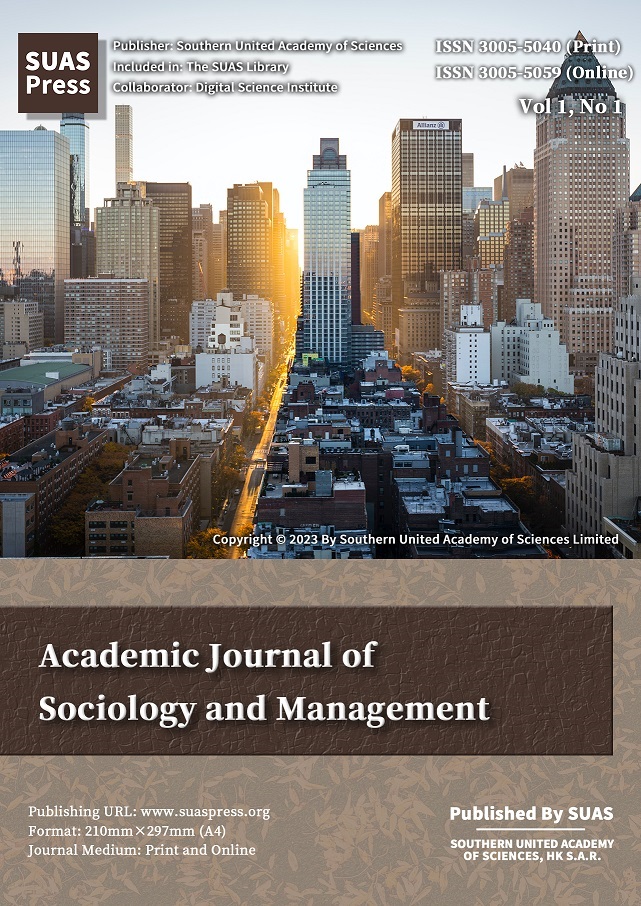
Current Issue

All articles published in this issue have undergone a thorough peer review process, and stringent checks for repetition rates have been implemented to ensure the integrity of the content.

Total number of articles in this issue: 1
Total number of pages in this issue: 6

For inquiries regarding the content of specific articles, please feel free to contact the respective authors via their provided email addresses. For questions related to the journal itself, please reach out directly to SUAS Press.

Year

2026

Volume

4

Number

2

Status

Archived

Published

2026 March 20

Articles

Research on Development Strategies for Empowering Ideological and Political Education in Higher Education Institutions Through Algorithmic Recommendation Technology

Abstract: As the primary arena for conducting and implementing ideological and political education, universities must adapt to the tide of development in the digital age.Algorithm recommendation technology, as a vital component of emerging digital-age technologies, holds significant importance for advancing the high-quality development of ideological and political education in higher education institutions. It is essential to actively explore the theoretical basis and practical foundation for leveraging algorithm recommendation technology to empower ideological and political education, while clarifying its critical value in this context. Concurrently, development strategies should be strengthened across three dimensions—technology, stakeholders, and institutional frameworks—to enhance the educational effectiveness of ideological and political education in higher education institutions.

DOI10.70393/616a736d.343030ARKark:/40704/AJSM.v4n2a01

Five-Society Collaboration: Connotation, Dilemmas and Paths

"Five-Society Collaboration" is an innovative grassroots governance model expanded on the basis of "Three-Society Collaboration", which takes the community as the platform, community social organizations as the service carrier, social workers as the service support, community volunteers as the service assistance, and social charity resources as the service guarantee. As a distinctive grassroots governance model, "Five-Society Collaboration" has great advantages in solving community problems, strengthening community connections, and activating community vitality. However, "Five-Society Collaboration" is still in the initial stage of development, facing dilemmas such as inefficient mechanism operation, shortage of professional talents, and insufficient community participation. It is necessary to improve the operation mechanism of "Five-Society Collaboration" by clarifying the boundaries of rights and responsibilities, developing social organizations, and introducing professional forces.

DOI10.70393/616a736d.343039ARKark:/40704/AJSM.v4n2a02

Copyright © 2026 The Author(s). Published by Southern United Academy of Sciences.
This work is licensed under a Creative Commons Attribution 4.0 International License , which permits unrestricted use, distribution, and reproduction in any medium, provided the original work is properly cited.