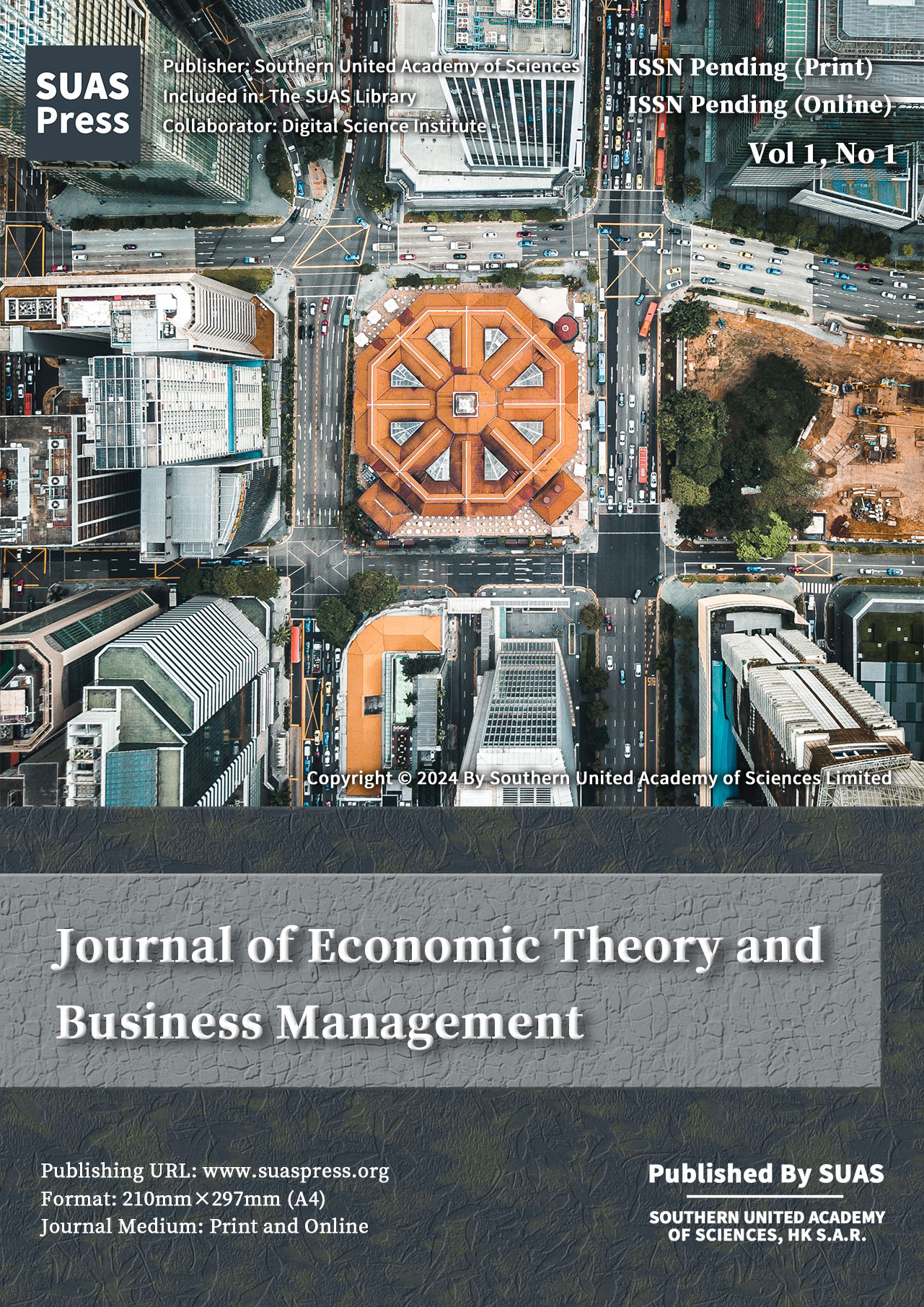
Current Issue

All articles published in this issue have undergone a thorough peer review process, and stringent checks for repetition rates have been implemented to ensure the integrity of the content.

Total number of articles in this issue: 1
Total number of pages in this issue: 5

For inquiries regarding the content of specific articles, please feel free to contact the respective authors via their provided email addresses. For questions related to the journal itself, please reach out directly to SUAS Press.

Year

2026

Volume

3

Number

3

Status

Archived

Published

2026 October 15

Articles

Research on Anti-Money Laundering Regulatory Issues and Risk Prevention and Control in Insurance Intermediary Channels

As the insurance industry evolves, intermediaries serve as a bridge between insurance companies and their clients. However, the complexity of transaction workflows and the diversity of fund flow mechanisms give rise to potential money laundering risks and challenges for effective regulation. This study identifies key anti-money laundering (AML) risk points within the core business processes of insurance intermediaries. It finds that regulatory challenges, specifically unclear and fragmented accountability alongside disjointed information systems, undermine core risk control measures. Consequently, the study proposes a series of targeted recommendations: establishing an integrated transaction monitoring system, leveraging fintech tools to strengthen internal compliance frameworks, and building a risk-based AML system tailored to the specific characteristics of insurance intermediary channels.

DOI10.70393/6a6574626d.343537ARKark:/40704/JETBM.v3n3a01

Institutional Pressures and AI Adoption in Chinese SMEs: a Neo-Institutional Analysis with Propositions

Artificial intelligence (AI) adoption has become a strategic imperative for small and medium-sized enterprises (SMEs) in the digital economy. In China, however, SMEs frequently exhibit a pronounced gap between AI awareness and sustained adoption. This paper applies neo-institutional theory—specifically DiMaggio and Powell's model of institutional isomorphism—to examine how coercive, normative, and mimetic pressures shape AI adoption among Chinese SMEs. Adopting a conceptual theory-building approach, the paper develops an integrated framework in which institutional pressures influence AI adoption intention through legitimacy-seeking motives, while organizational capability and resource endowments moderate whether adoption becomes substantive or symbolic. The analysis identifies a legitimacy–capability paradox: institutional pressures may accelerate initial AI experimentation while simultaneously encouraging decoupled, compliance-oriented adoption. The paper contributes to institutional theory and technology adoption research by explaining not only why Chinese SMEs adopt AI but also how they adopt it. Seven propositions and five analytical tables are developed to guide future empirical research.

DOI10.70393/6a6574626d.343338ARKark:/40704/JETBM.v3n3a02

AI Adoption and Dynamic Capabilities in Chinese SMEs: the Mediating Role of Digital Entrepreneurial Orientation—A Conceptual Framework

This paper develops a conceptual framework that examines how artificial intelligence (AI) adoption may influence dynamic capabilities in Chinese small and mediumsized enterprises (SMEs), with digital entrepreneurial orientation (DEO) as a proposed mediating mechanism. Drawing on dynamic capabilities theory and the digital entrepreneurship literature, the paper argues that AI adoption does not automatically translate into dynamic capabilities. Rather, AI adoption may foster DEO—comprising digital innovativeness, digital proactiveness, and digital risktaking—which in turn may help firms sense opportunities, seize them, and reconfigure resources. Three testable propositions are developed. The framework contributes to dynamic capabilities theory by specifying DEO as a strategic mediating pathway through which AI resources may be converted into organizational capabilities. It also offers implications for SME managers and policymakers seeking to support digital transformation under resource constraints.

DOI10.70393/6a6574626d.343339ARKark:/40704/JETBM.v3n3a03

Copyright © 2026 The Author(s). Published by Southern United Academy of Sciences.
This work is licensed under a Creative Commons Attribution 4.0 International License , which permits unrestricted use, distribution, and reproduction in any medium, provided the original work is properly cited.