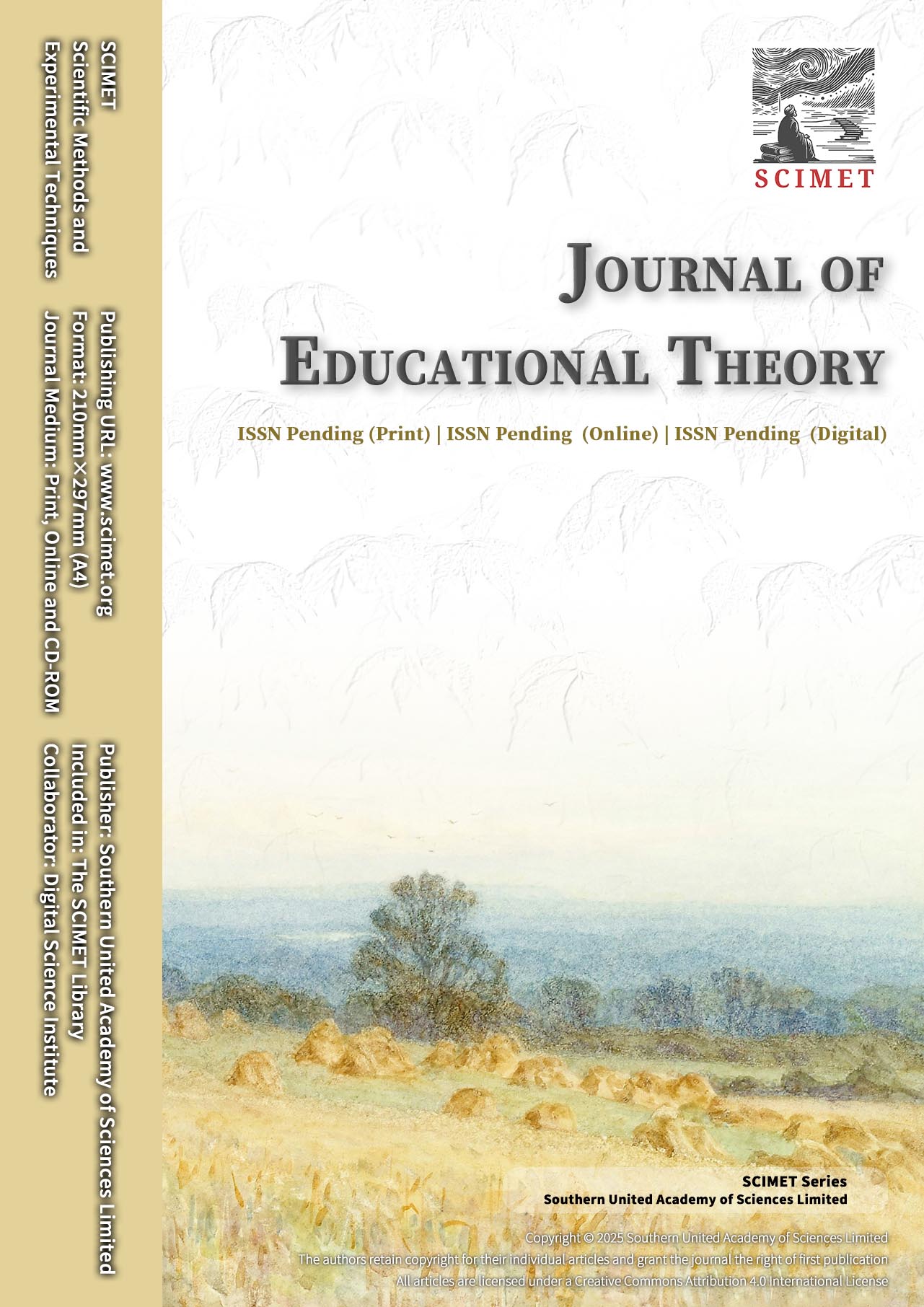
Current Issue

All articles published in this issue have undergone a thorough peer review process, and stringent checks for repetition rates have been implemented to ensure the integrity of the content.

Total number of articles in this issue: 2
Total number of pages in this issue: 12

For inquiries regarding the content of specific articles, please feel free to contact the respective authors via their provided email addresses. For questions related to the journal itself, please reach out directly to SUAS Press.

Year

2025

Volume

2

Number

2

Status

Archived

Published

2025 August 21

Articles

The Dilemma and Opportunity of Music Students Under China's College Entrance Examination System

This study examines China's college entrance examination (Gaokao) system, analyzing cultural barriers and regional disparities faced by music students through provincial admission data and case studies. The Gaokao mechanism disproportionately disadvantages talented musicians, reducing the nation's musical talent pool. Art educators explore the root causes of this educational dilemma while highlighting opportunities arising from Gaokao reforms and digital technologies. Research reveals that in Henan Province in 2024, approximately 12% of top-scoring art candidates failed to gain admission due to failing cultural score thresholds, with remote region students being admitted at one-third the rate of urban peers. Policy adjustments (e.g., merged admission batches) and market shifts (e.g., digital music industry expansion) are reshaping career pathways for music professionals. The paper advocates reforming the Gaokao system to ensure fair talent selection and enhance training effectiveness.

DOI10.70393/6a6574.333131ARKark:/40704/JET.v2n2a02

Piano Music Training as a Teaching Support for Educational Problems in Modern Universities in China

Piano music training occupies an important position in our country's higher education system, not only as a core course for music majors, but also widely used in general education and comprehensive quality training. However, piano education in Chinese universities still faces many problems such as single teaching methods, unreasonable curriculum, and insufficient practical ability of students. This paper discusses the supporting role of piano music training in modern university education, analyzes its existing problems, analyzes the characteristics of Chinese and Western piano repertoire to trigger the importance of students' basic training, takes the analysis of the characteristics of Chinese and Western piano repertoire to trigger the importance of students' basic training, takes it as a starting point to fundamentally cultivate students' musical literacy and interest in music, and puts forward an optimization strategy to promote the sustainable development of music education. In short, piano education can promote the overall coordination of college students' bodies, and from the psychological aspect, piano education can improve the willpower of college students and stimulate their creative thinking, and the mutual communication and cooperation in piano performance can cultivate students' collectivist concepts.

DOI10.70393/6a6574.333132ARKark:/40704/JET.v2n2a01

Copyright © 2026 The Author(s). Published by Southern United Academy of Sciences.
This work is licensed under a Creative Commons Attribution 4.0 International License , which permits unrestricted use, distribution, and reproduction in any medium, provided the original work is properly cited.